
11th – 15th August
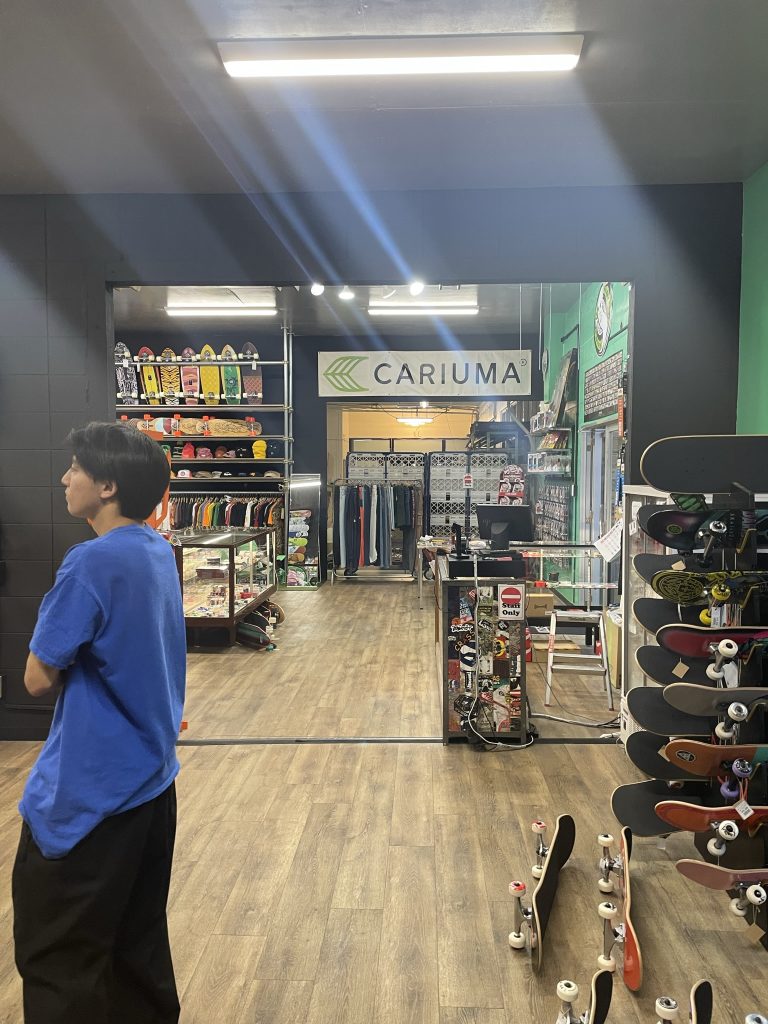
Through my friend who works at the skate shop I was able to get a small practica and
they also needed someone who spoke english as there are a lot of americans coming to
the shop and the staff mostly lacks when it comes to proficient english. In this post I will
dive into the working culture and compare it to what I know of Switzerland.
Working in Okinawa offered me a unique cultural experience, especially compared to
Switzerland. The working culture in Okinawa, and Japan as a whole, tends to emphasize
“collectivism”, meaning there’s a strong focus on teamwork and community harmony.
This is different from the more “individualistic” culture that I know of, where
independence and personal initiative are highly valued. To this I also have funny thing
that has happened to me on the third day. So for some context usually at the restaurant I
work at in Switzerland I tend to observe what my chef the service does and the next time
I work I do one of those tasks when I have a hand free. I tried to do this as well in Japan
and the first thing I got asked why that I am now doing a different task then the one I was assigned to.
I explained that I had already finished my other task and wanted to start
with the next one. Then it was kindly explained to me that I have to ask someone before
starting something else, even if it meant waiting till that person showed up or someone
else who is a “higher” rank gave me permission. Which I thought was quite funny as I
then somewhat “wasted” my waiting time only to do the task after I got permission. This
has definetly been something that I have experienced which was new. Another thing I’ve
noticed is that in Japan, there’s often an expectation to prioritize the group over the
individual , and communication can be indirect due to the “high-context” culture, where
much is understood without needing explicit explanation. In contrast, Switzerland’s
“low-contex” culture relies on direct and clear communication. For instance, at Sunabe,
I noticed that colleagues avoid disagreement to maintain harmony, while in Switzerland,
open debates are more common.
Another thing I struggled with was that “Hierarchy” is also more important in Japanese
work culture. Even in a casual environment like a skate shop, respect for seniority is
important. Decision-making is way more centralized, with the manager or senior staff
taking the lead, compared to Switzerland, where even I have often something to say
during the decision-making processes. The thing with the hierarchy is what I have
noticed is that it is often also tied to the age of someone. As there is a “respect” culture
in Japan where people who are older even get addressed or spoken to differently.
One of the most noticeable differences to me was the concept of “omotenashi”, or
Japanese hospitality. Here the customer is truly King. At Sunabe, I also tried to focus on
anticipating customers’ needs, providing a warm, respectful experience. Even though it
might seem unecesssary or atleast to me it did as a Skateshop has usually a very casual
setting. For example in Switzerland, customer service might still be polite, but there’s
often a greater emphasis on efficiency rather than creating a experience with and for the
customer. I learnt that things work differently around here, and that customer especially
japanese one expect great service.
When it comes to the language I was also often reminded that I had to use “keigo” (敬語)
which translates into “respectful language” this is a system of “honorific” speech which
is typically used when talking customers or “higher-ups”. As I had never properly
learned this has also been a challenge for me but on the other hand also a nice
experience as I felt more professional after learning some customs.
Lastly, the work-life balance can also differ. In Okinawa, there might be longer working
hours and more of a “live-to-work” attitude, whereas in Switzerland, there’s a strong
emphasis on balancing professional and personal life, with shorter working hours and
more holidays. However, being in Okinawa, which has a more relaxed island vibe
compared to mainland Japan, I find that the atmosphere at Sunabe Skate Shop is more
laid-back than it would be in a major Japanese city. And the same goes also for the
working experience I can say that working in a skate shop has definetly been a more
casual setting compared to the “normal” japanese working culture.
So what can I connect to the theory after this experience?
The following part is similar to the one I did on the 4th of August but as time has past, I
think I was able to gain a few new insights and I also want to try to connect the theory to
the working culture.
Ever-Increasing Mobility (Globalization)
Globalization plays a central role in shaping work environments like Sunabe Skate Shop.
The fact that I was brought in to help with English-speaking customers, particularly
American visitors from the nearby Kadena Air Base, reflects the growing global
interactions that businesses in Okinawa face. Also the fact that the skate shop can
survive is also due to the fact of the globalization of trends meaning through social
media more people want to skateboard hence a shop can maintain itself on a local
level.
Iceberg Model of Culture
The “Iceberg Model of Culture” shows that most cultural elements are “below the
surface,” meaning they are not immediately visible but are felt through values,
communication styles, and traditions.
At Sunabe, while the external behaviors such as politeness and customer service are
visible, the deeper cultural values of “hierarchy” and “collectivism” only became
evident to me through daily interactions. The expectation to ask for permission before
starting new tasks (as I learned on my third day) highlights the unseen cultural rule that
prioritizes structure and respect for authority, which contrasts with Switzerland’s more
independent working style.
High-Context vs. Low-Context Communication
As I’ve mentioned before Japan is a “high-context” communication environment. My
experience of being asked why I took on a task without asking first was an example of
this. The assumption was that I would know to wait for instructions, whereas in
Switzerland’s “low-context” culture, tasks are often completed with more autonomy
and direct communication. This difference required me to adjust my behavior especially
because I wanted to fit in with the expectations.
Cultural Dimensions and Six Cultural Dimensions
- “Power Distance”: In Japan this is higher, meaning there is a strong emphasis on
hierarchy. Even in a casual setting like a skate shop, there was a clear sense of respect
for seniority, both in age and rank. In Switzerland, workplaces tend to be more equal I
would say, where decision-making is often shared and authority is more distributed. But
what I have also noticed is that maybe because Okinawa is an Island and Skating is
traditionally in a more casual setting the power distance didn’t feel a big as I can
imagine it to be in a different work environmennt. - “Individualism vs. Collectivism”: Japan’s collectivist culture contrasts with
Switzerland’s individualistic mindset. In Okinawa, teamwork and group harmony are
essential, as I could see by the need to follow prescribed roles and seek approval from higher-ups. In Switzerland, personal initiative and independence are valued, and
stepping up to take on tasks is seen as a positive trait. - “Masculinity vs. Femininity”: Japan leans towards a “masculine” culture, with a focus
on achievement and performance. However, the customer service experience in
Okinawa felt more aligned with a “feminine” orientation, especially through the practice
of “omotenashi” (Japanese hospitality). Switzerland is more balanced between the two,
where efficiency and work-life balance are both valued. - “Uncertainty Avoidance”: Japan has a high “uncertainty avoidance” score, meaning
there is a preference for structure, rules, and predictability. My need to wait for
instructions rather than independently taking on tasks is part of this cultural norm.
Same I have also noticed when it comes to punctuality the japanese also value
punctuality highly just like in Switzerland. In contrast, Switzerland tends to be allow
more flexibility in how tasks are approached. - “Long-Term vs. Short-Term Orientation”: This has been something I have noticed
throughout my stay, Japan often favors a “long-term orientation”, where traditions and
long-term relationships play a significant role. In the shop, this showed in a focus on
building long-lasting connections with customers, but noting not on a personal level it
seemed more like that the customer service should make a long- lasting impression. - “Indulgence vs. Restraint”: Japan leans toward “restraint”, with a strong sense of
social norms and duty. However, in Okinawa, the island’s relaxed vibe brings a slightly
more “indulgent” atmosphere, or atleast I have felt to notice this. Where enjoying life
and leisure plays a more significant role compared to mainland Japan.
Other Dimensions include the:
- “Achievement vs. Ascription”: In Switzerland, one’s role is often based on
“achievement” that’s how I have experienced it so far. Where what you’ve
accomplished gives you status. In Japan, and particularly at Sunabe, I noticed a more
“ascription-based” culture, where age and rank play significant roles in determining
respect and authority. - Acculturation Matrix
Applying “John Berry’s Acculturation Model”, my experience at Sunabe Skate Shop
shows a degree of “integration”—a mix of both cultures. While I adapted to Japanese
norms of hierarchy and communication, my role as an English-speaking staff member
catering to foreign customers also brought my own cultural influence into the
workplace. I also feel like that the influences of the american base has been something
which has influenced the culture and of course the skating culture. Which is known to
be more rebellious.
Speaking of rebellious I have noticed that the Skaters in Japan specifically Okinawa are
still in my eyes more true to the roots of skateboaring. It really has something rebellious
about the skaters which kind of brake out of the strict societal norms in Japan. Where in Switzerland it seems like the Status of a “normal” hobby has reached skateboaring and
it isn’t as frowned upon as in Japan which has changed the culture a bit. This integration of cultures at the shop allowed for mutual changes which leads to a shop which in my eyes can perfectly cater to “traditional” japanese customers as well as international ones. - Cultural Sensitivity
The experience at Sunabe taught me the importance of “cultural sensitivity”.
Understanding and respecting Japan’s hierarchical structure, communication styles,
and customer service expectations enabled me to fit into the workplace better. At the
same time, my background from Switzerland allowed me to bring a fresh perspective,
particularly when interacting with the american customers.
Conclusion and Reflection:
This opportunity has been a amazing addition to my Culfox stay and I feel like I have also
noticed now why it is important to work abroad. The diIerence between working and
visiting is a completely diIerent especially if you would just visit as a tourist. Through
this opportunity I feel like even if it was for a short time period I got immersed fully into
the Okinawan way of life. And im not only saying this because I was able to connect the
theory with the real life but also because as the Ice berg model suggests things which
are not visible make up for such a big part in culture. I feel like the working opportunity
gave me the possibility to uncover these things and connect more especially with my co
workers with which I shared many meals and time. I feel like this opportunity has also
once again proven to me why I have chosen tourism as my study field and that I truly
enjoy the experience a lot.