
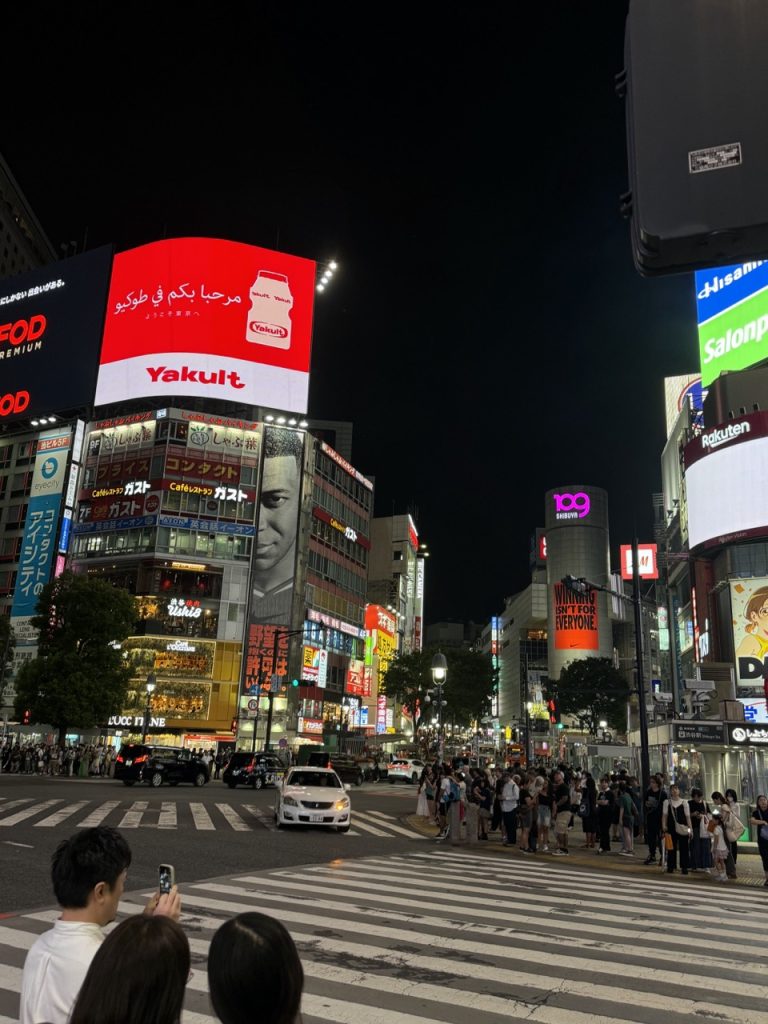
26th July
Today I’ve decided to have a look at Shibuya’s famous crossing and I wanted to write a analysis about this crossing which has become somewhat of a tourist attraction. As I have seen in the past on social media it intruiged me why and how this crossing has become so famous and does it really attract visitors like a tourism destination would?
Historically the Shibuya Crossing, also known as the “Shibuya Scramble,” is located in Tokyo, near Shibuya Station. This is one of the busiest railway stations in the world. Its history as a major intersection dates back to the early 20th century, but it became a bustling symbol of modern Tokyo in the post-war era as the city underwent rapid development. Shibuya itself grew into a commercial and entertainment district in the 1970s and 1980s. This made the crossing into a hot spot where thousands of people cross at once during peak hours.1
The crossing is right at the heart of Shibuya, surrounded by billboards, high-rise buildings, and massive screens wherever you look, it is the perfect example of the energy of Tokyo’s urban landscape.
But how did it gain such fame? Behind Shibuya Crossing’s global fame is probably its sheer scale and visual appeal. At peak times it can host over 1,000 pedestrians crossing from all directions at once. This makes it one of the busiest intersections in the world. The surrounding area has bright lights and enormous screens these things turn the crossing into an urban image which is often associated with Tokyo’s modernity and energy. Media exposure has also helped to gain fame. Shibuya Crossing has been featured in a lot of films, music videos, and TV shows. Also in Western pop culture. For example the movies “Lost in Translation” which my parents actually love and “The Fast and the Furious: Tokyo Drift” which has been a childhood movie for me have featured the crossing. The crossing’s regular appearances in international media have helped cement its place as a globally recognizable symbol of Tokyo. And of course the hype on social media doesn’t fall short.
With Shibuya Station being one of Tokyo’s busiest transportation hubs, and the crossing lies just outside its Hachiko Exit. The crossing’s accessibility has helped it become a meeting point for both locals and tourists.
When it comes to cultural significane the crossing represents a fusion of modern Japanese culture and the bustling, fast-paced life of Tokyo. It symbolizes Japan’s urbanization and technological advancements, but also its ability to maintain order within chaos. The point of maintaining order has been something I noticed right away because even though people cross whilst using their phones it seems like they are walking on designated rails as I’ve yet to observe a collision
So far so good but why did it become a tourist attraction? Firstly we can say crossing has become somewhat of a “Iconic Experience” for tourists, experiencing Shibuya Crossing is about more than just crossing a street—it’s about being immersed in a moment of controlled chaos that represents the fast pace of Tokyo life or at least this is what it makes me feel like.
It gives visitors a sense of Tokyo’s urban energy, making it a highly social media worthy moment.
Another reason is the central Location for exploring Shibuya because convieniently the shibuya Crossing serves as the gateway to one of Tokyo’s trendiest districts. Shibuya has numerous fashion boutiques, restaurants, bars, and entertainment venues all close together. And if tourists plan to go to these attractions they naturally pass through Shibuya Crossing,. This helps it making it into a must-visit spot.
Notebly over time, the businesses surrounding Shibuya Crossing have capitalized on its fame. Cafes like the Starbucks overlooking the crossing offer prime views, allowing tourists to watch the spectacle unfold from above. Additionally, new developments such as the Shibuya Scramble Square, which features an observation deck offering panoramic views of the crossing, provide further incentive for visitors to experience it from different perspectives.With all these points it seems impossible for the Shibuya crossing to have failed as a tourist attraction. But let me tell you it could have also gone a completely different way. The reason why it hasn’t is because the government and surrounding business have always invested in the area as a hub so it never lacked surrounding attractions. Also it has always shown no lack of media exposure. But most importantly from a cultural aspect Japan has had a reputation as a high-tech, fast-paced society, if this was not the case the crossing might not have had the same attractivness for tourists.