
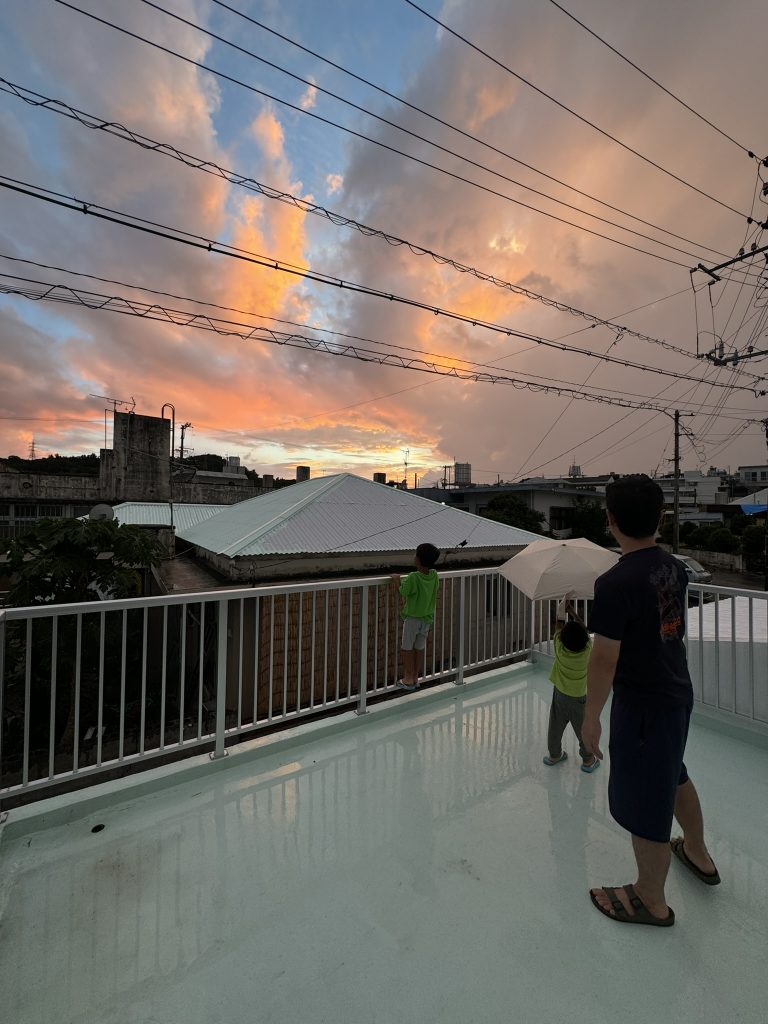
A picture of our neighbours who came to visit for Obon.
16th August
Today marks the day of Obon, a Japanese traditonal fest, even though today is my “free”
day I wanted to provide some information as I have mentioned it in Tokyo and tradition
also plays a important role for culture.
Obon (お盆) is one of Japanʼs most significant traditional celebrations, typically
observed in mid-August. It is a Buddhist custom that should honor the spirits of ancestors.
It is believed that during obon the spirits of deceased family members return to visit
the living. And so families pay respect to their ancestors through various rituals.
In Okinawa it is also forbidden to swim during some parts of the festival especially
during the “send-oI” where it is believed to say that the ancestors return to the afterlife
after their visit through the sea. There are many things I didn’t know about the festival
and I wrote down some elements which I have noticed during it and I have also talked to my grandmother about it. Since my father is the first born son in their family, he usually would be responsible for most of the rituals but since he lives in Switzerland this time it was my duty as I am his only son.
Key Elements of Obon:
Home Altars and Offerings: It is important that families set up altars with food, fruits, and flowers to welcome the spirits of their ancestors. Incense is often burned especially when guests come they also pay respect to the respective ancestors. And sometimes even special lanterns, called “Bon Odori lanterns,” are placed to guide the spirits back home. In our case we only set them up at our altar.
Grave Visit: A central tradition of Obon is visiting family graves to clean and decorate them. Families often travel back to their hometowns for this purpose, making it a time of homecoming for many Japanese. This year I won’t be able to participate but I remember that I have partaken in it before. Usually we also rest at the grave site and have a picknick with everybody together. This might seem morbid to western culture but in Japan graves are usually family graves which means everybody gets buried together. I also think that Japanese graveyards don’t give off the same feeling as western one were the layout can often lead to a eerie feeling.
Bon Odori (盆踊り): This is a traditional dance for Obon festivals. Bon
Odori is a joyful dance that is meant to celebrate and uplift the spirits. The dance in Okinawa was performed by the Aisa which is a traditional drum “club” from
Okinawa they walk through the neighbourhoods and perform for the spirits.
Toro Nagashi (灯籠流し): On the final day of Obon where I wont be able to attend,
floating lanterns are released onto rivers or the sea to guide the spirits back to the other world. This beautiful ceremony symbolizes the departure of the ancestorsʼ spirits after their visit. But in Okinawa this tradition isn’t as present as in the rest of Japan. Reason is the environmental protection which is important especially for the life close to the sea.
When it comes to cultural significance, obon serves as a reminder of family ties and the
importance of remembering one’s ancestors. It blends the Buddhist practices with
Shinto beliefs, which involve reverence for nature and spirits. I have also noticed that
there is more importance when it comes to honouring the ancestors compared to
Switzerland. Atleast for me that’s the case because I have noticed that I know more
about my grand- grand parents in Japan rather than in Switzerland but this might also be different for other families. I have also noticed that the festival is not only religious but more social and cultural. Especially when it comes to my family as I don’t think they are very religious.
Obon and Modern Japan:
Even though Japan is highly modernized, Obon keeps its importance. It’s a time for
reunion and reflection on family bonds and ancestral heritage, keeping traditions alive.
Many businesses and schools close during Obon as people travel back to their
hometowns.
I can say that it was a really important experience for me not only because as I grow
older my interest into my heritage across the globe grew but also because I got to share
this experience with my grand parents. Which gave me a feeling of connection which I
rarely feel due to the distance which separates me with this world.