31st – 4th August
These last few days have been pretty similar, so I wanted to make use of this post to
share a bit of Information about my “Day in the Life” video. Which I hope can give you a
good idea on how a normal day usually looks during my stay. As for the Video you can
also find it attached below.
In the video I have mentioned the Ice- Berg model of culture and originally it was also my plan to cover it in the Video but while looking at my footage I realised that this would exceed the 10 minute limitation by far so I’ve decided to use this post as a canvas for my thoughts.
The Ice-Berg Model of Culture1
As I have learned in class, I want to first quickly explain how this model works. In the
model the components of culture are cut into three levels:
Level 1: These are visible such symbols and cultural artifacts, (for example bowing,
language customs, rituals)
Level 2: This is the first level which is invisible and include the values and norms which
then become visible through the symbols. (For example, bowing as a way of thanking
someone.)
This level is important for noticing behaviours within society.
Level 3: This level is the hardest to reach without growing up in the culture as here the
basic assumptions and attitudes that exist in the subconscious of people are placed.
(For example, the general view on the world and on people.)
So here is where I would place the things I’ve learned and observed during my stay in
Okinawa and Taipei. Both working environments have helped me reach deeper within
the levels of the Iceberg which I would not have been able to notice otherwise. Or at
least I can say that my claims are based on experience rather than on assumptions.
Okinawa / Sunabe skate shop:
Level 1:
- Friendly but distanced customer service (omotenashi)
- Calm and collected
- Keigo – The way of respectful Japanese speech
- Welcoming and thanking of the customer upon entry and exit
- Clear rules and signage
- Body language – no sitting down while customers are in the store
- Music which is played in the store
- Clothing of the workers, (influenced by the skateboarding culture there is no
clear dress code.) - Appearance, haircut and make-up (As the skate shop is heavily influenced by
skateboarding culture there are no strict rules regarding appearance, but I have
noticed and seen that in Japan it is normal that a workplace has strict rules when
it comes to the appearance. For example, it is often not allowed to have dyed
hair, tattoos, painted nails or even make-up for women.)
These where some of the most prominent things I have noticed, and we can now
continue to the second level and try to find out the roots of these behaviours.
Level 2:
- High- context culture (often no clear orders given same goes for customer
interaction) - Hierarchy (seniority and rank)
- Omotenashi is the meaning to wholeheartedly look after guests which has deepcultural roots in Japan. It comes from the tradition of tea ceremony. I am unsure if this has such a cultural significance that I could even place it in Level 3.
- Value of community (communitarianism, as for the appearance for example
where in Japan it is often more important to fit in with society rather than
standing out. - I’ve also noticed that in Japan showing emotions is rather frowned upon which is
also the reason why I wrote down Calm and collected on the first level. - Skateboarding culture (rebellious, free)
These were some of the things which I was able to learn during my stay and I am sure
that I still could learn way more. I’ve really noticed how deep the topic of culture can be
and even though I have thought to know a country well I have realised how wrong I was
with my assumption.
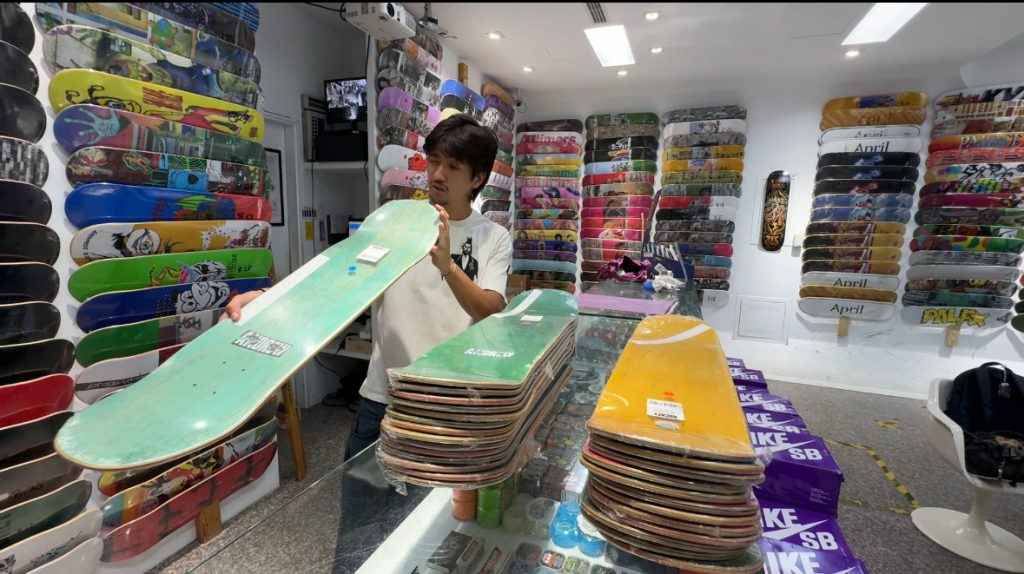
Taipei / 9CE Skate shop
Level 1:
- Friendly and familiar customer service
- Laughing and emotions
- Normal speech (as far as I noticed)
- Welcoming and thanking of the customer upon entry and exit
- Body language
- Music which is played in the store
- Clothing of the workers, (influenced by the skateboarding culture there is no
clear dress code.) - Appearance, haircut and make-up (As the skate shop is heavily influenced by
skateboarding culture there are no strict rules regarding appearance, but I have
noticed and seen that similar to in Japan it is normal that a workplace has strict
rules when it comes to the appearance.) - Something I have observed in Taipei is that tattoos are not as frowned upon as in
Japan as I have seen multiple people who wear them openly
These where some of the most prominent things I have noticed, and we can now
continue to the second level and try to find out the roots of these behaviours.
Level 2:
- High- context culture but a lot clearer than Japan
- Hierarchy (seniority and rank)
- In general, I think the value of community is also important like in Japan but again
here it felt a little bit more lenient towards individualism - I’ve also noticed that in Taipei showing emotions is rather normal in contrast to
Japan - Skateboarding culture (rebellious, free)
That’s why when it comes to the third level of the Iceberg, I don’t think this time here
was enough to allow me to categorize what lies in those depths. Nevertheless, I want to
try challenge myself and write about what I’ve learnt so far.
So first I want to compare the two shops when it comes to the visible level. I don’t think
they were too different besides the language which was obviously different but when it
came to appearance and both shops gave the feeling of a skate shop. Which made me
think that this sub- genre of culture which was created through Skateboarding was
similar all over the world.
But I quickly learned that both shops might have made use of the appearance of the
skateboarding culture but on a deeper level they where still businesses with the values
and norms of Okinawa and Taipei.
These cultural elements, I was only able to experience through being there day by day
and I was firstly astonished by how much I didn’t know. Of course, I was expecting to get a cultural shock in Taipei, but I didn’t expect it in Okinawa.
As you may know Okinawa is the Island where my father grew up and because of that I
had the assumption of knowing its culture as well. I can now say I was completely
wrong, of course I was able to navigate better because I partially grew up in a Japanese
household but the number of things that I wasn’t aware of shocked me. From not
knowing the basic history of the Islands to the proper way of speaking with customers I
had a steep learning curve.
I think that the experience in Okinawa helped me prepare for Taipei, as it was pretty
similar if not a little bit easier as the working culture was less strict as I had expected.
Overall, I can say that the working experiences have been great in both places, and I
think it will help me for my future approaches within my studies. Not only do I think I
have learned to be more sensitive to cultures, but I think I have also gained a lot of
patience and perspective when it comes to approaching intercultural problem solving.
Now I look forward to work on the 6th & 7th and then my stay already comes to an end.
- Dr. Thuc Lan Tran, Cultural Dimension, Lesson 1, 2024 ↩︎